








Warehouse Rack Repair: Why Protection Matters as Much as the Fix Itself
A rack repair restores a rack column that has already been struck, while a protector or guard rail is aimed at making sure warehouse rack repair on that same spot never needs to happen again.
A warehouse that treats prevention as an afterthought keeps paying for the same repair in the same spot, while a warehouse that budgets for protection at high-risk columns breaks that cycle. Every warehouse has a handful of locations where this pattern shows up, and every warehouse benefits from addressing them directly rather than repeatedly.
Warehouse rack repair addresses damage after the fact. Column protectors and guard rails address the same risk before it becomes damage. Installing them at a warehouse’s most vulnerable points is often the difference between a one-time fix and a recurring one.
What a Column Protector Actually Does
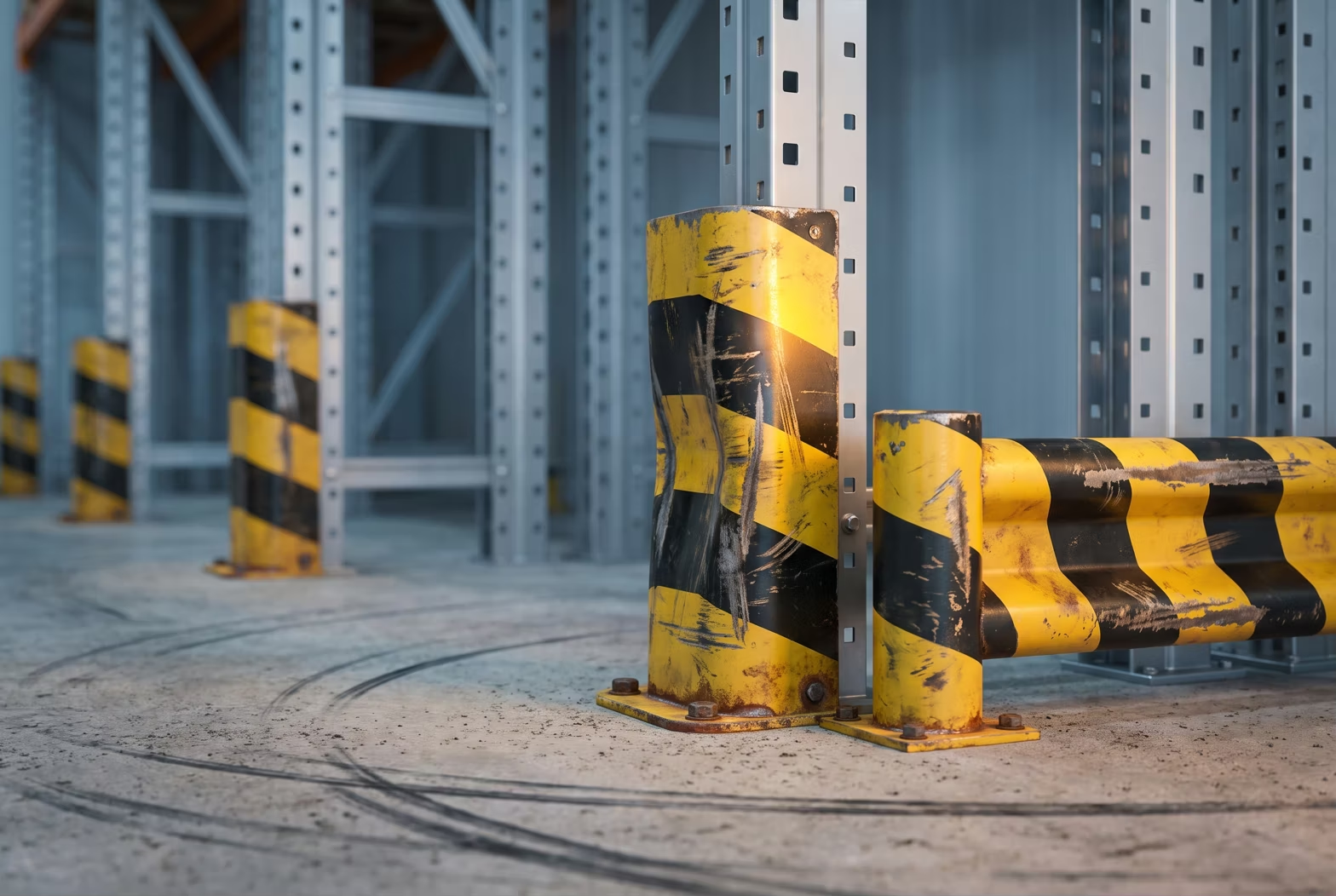
A rack column protector wraps or bolts around the base of an upright in a warehouse, absorbing and deflecting a forklift strike before it reaches the steel column itself. It is a sacrificial layer by design, built to take the impact that would otherwise land directly on a warehouse rack column and its rated capacity.
Bright, high-visibility coloring on most protectors serves a secondary purpose in a warehouse beyond the impact absorption itself. A clearly marked column edge gives a driver an extra visual cue in exactly the spot where clearance judgment tends to fail.
Because it is meant to absorb damage rather than avoid it entirely, a protector itself needs periodic inspection. A protector that has already taken several hits and is showing wear is doing less to shield a warehouse rack column than a fresh one, even though it has not failed outright.
What a Guard Rail Adds That a Protector Doesn’t
A guard rail, typically anchored to the floor in front of a warehouse rack run or at an aisle end, stops a forklift before it reaches the column at all, rather than absorbing an impact that has already made contact. This makes guard rails especially useful for a rack run at the specific spots where repeated damage has already shown a clear, repeated pattern of forklift contact building up over an extended period of time.
The two are not competing options for a warehouse so much as complementary ones. A guard rail at an aisle end and a rack column protector on the individual uprights behind it address the same risk at two different distances from the steel.
Floor markings and mirrors are both worth a warehouse considering alongside these two options, even though neither one is technically a physical barrier at all. A convex mirror placed to improve visibility around a blind corner, or floor striping marking a rack column’s actual footprint, can reduce the frequency of contact in the first place rather than simply absorbing or blocking it once it happens, at a fraction of what either a protector or a guard rail costs installed.
Where Protection Belongs After a Repair
The same column in a warehouse that just took a strike is statistically more likely to take another, given that whatever traffic pattern caused the first impact is still in place. Installing a protector or guard rail as part of the rack repair, rather than as a separate later decision, addresses that risk while the crew and the access are already on site.
Why This Is Cheaper Than It Looks on Paper
A protector or guard rail costs a warehouse a fraction of a rack repair kit, and considerably less than a full column replacement. Comparing that cost against the price of the same repair happening again within a year makes the case for protection at the point of highest risk rather than treating it as an optional add-on.
Downtime avoided is part of that comparison for a warehouse too, not just the parts and labor. A rack column that never gets struck a second time never sends a warehouse a second repair visit, a second period of reduced bay availability, or a second round of the disruption any repair brings with it.
Why Prevention Advice Should Be as Unbiased as the Repair Itself
Recommending column protectors or guard rails is a judgment call too, and it deserves the same unbiased standard as the rack repair recommendation it follows. 1 Stop’s over 30 years of experience support an agnostic view into both the rack repair and the prevention measures that make sense for the specific damage pattern. A provider selling a single product line has a reason to recommend their own accessories regardless of fit. Depending on the situation, a different manufacturer’s protective equipment, or a layout change instead, can be the more appropriate prevention measure. Reaching the right combination takes a partner without one line of accessories to sell.
Building Protection Into the Repair Recommendation
1 Stop flags high-risk locations for protection as part of a warehouse’s rack repair assessment itself, rather than leaving it as a separate conversation after the fact. That habit reflects decades of seeing which specific spots in any warehouse tend to get hit more than once.
A warehouse tracking its own repeat-damage locations has an easier time justifying the upfront prevention cost, since that warehouse can point to its own repair history as the reason.
That history doesn’t need to be sophisticated to be useful. A simple tally of which column got hit, how many times, and when is usually enough to spot the two or three locations worth protecting before the fourth repair on the same spot becomes the one that finally prompts the question.
Warehouse rack repair addresses what already happened. 1 Stop builds protecting the same spot into that same visit, which is what keeps the next call from being the same call all over again.