








Warehouse Rack Repair: Why Damage Spikes During Peak Season
Rack damage does not spread evenly across the year, and the same predictable pressures that drive a warehouse’s busiest weeks are what push warehouse rack repair calls to climb right alongside them.
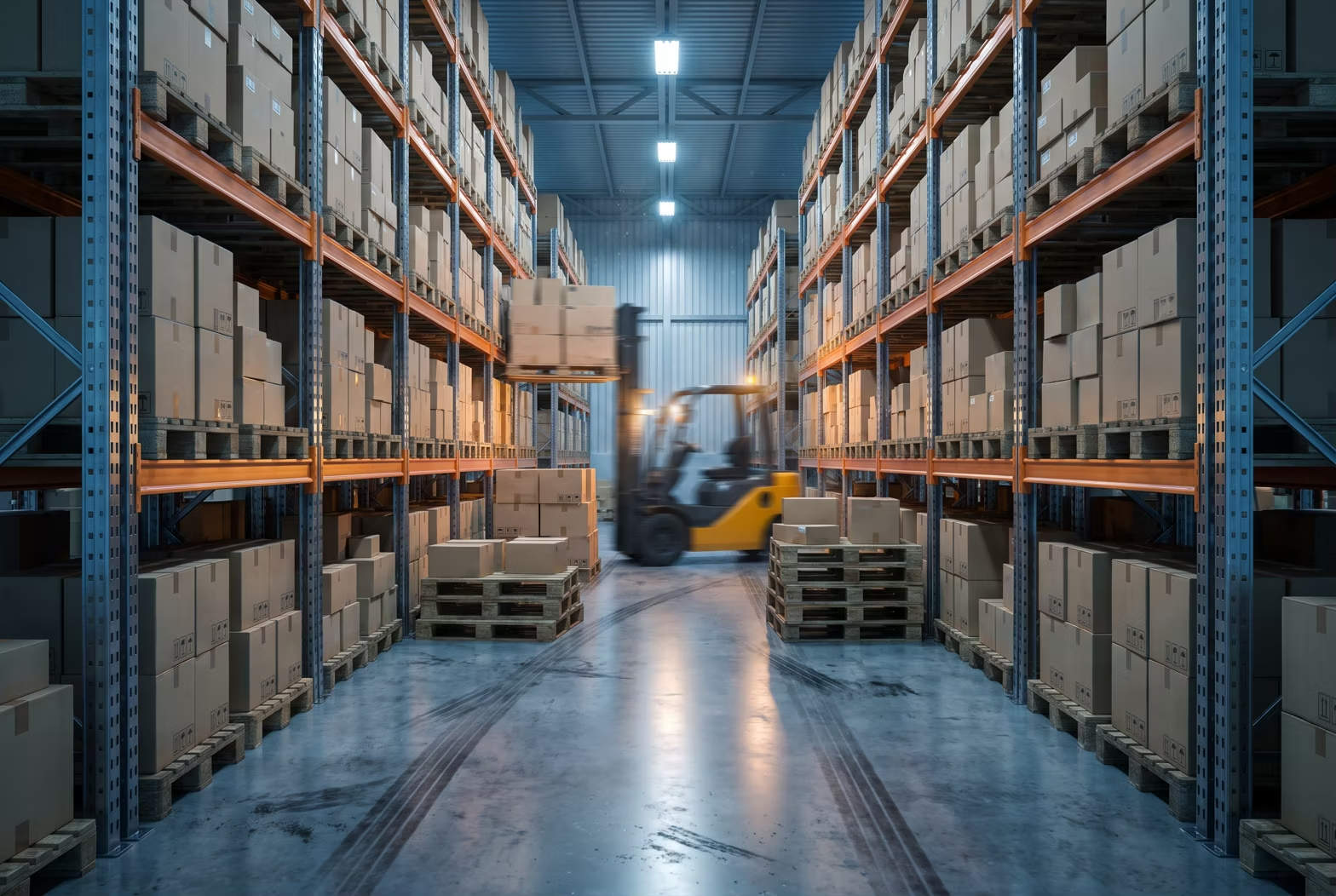
Warehouse rack repair calls follow a pattern most warehouse operations managers already sense without having tracked it formally, since they climb sharply during peak season and settle back down once volume normalizes. The reasons behind that spike are consistent enough to plan around.
More Product Movement Means More Chances for Contact
Every pallet moved through a warehouse is a chance for a forklift to pass near a rack column. Peak season multiplies that exposure simply by multiplying the number of moves happening in the same aisles every shift. A warehouse running double its normal throughput is not just moving more product. It is running that much more equipment past every upright, every day, for weeks at a stretch.
Faster warehouse pick and putaway targets compound the exposure. Warehouse staff working against tighter time pressure make small judgment errors more often. A rushed turn around a rack end is exactly the kind of contact that leaves a dent, even when the driver corrects course within seconds.
Extended warehouse shift lengths add a quieter version of the same risk. Fatigue late in a long peak-season shift slows reaction time in small ways that rarely show up until a near-miss becomes contact, and the last few hours of an extended shift are disproportionately when that contact happens.
Temporary and Seasonal Staff Change the Risk Profile
A warehouse that scales up with seasonal drivers is putting people least familiar with the warehouse’s specific layout behind the equipment doing the most damage-capable work. A driver who has never learned where the tight corners sit, or which aisle ends have a known blind spot, is statistically more likely to be the one who clips a rack column.
This is not a criticism of a warehouse’s seasonal staff. It is a straightforward fact about experience. The same warehouse layout that a veteran crew navigates without incident becomes measurably riskier once new hands are added at volume. That risk shows up fastest in the first week or two, before newer drivers build their own sense of the space.
Inventory Levels Push Racks Closer to Their Limits
Peak season often means a warehouse’s racks are loaded closer to their rated capacity than during slower months, sometimes with heavier or differently shaped pallets than the layout was originally planned around. A rack column already carrying weight near the top of its rating has less margin to absorb an impact without exceeding its tolerance. The same strike that would be a minor concern in a lightly loaded warehouse bay can be a real one during peak.
Why an Unbiased Repair Partner Matters Most When Volume Is Highest
Peak season produces more damage calls, and a warehouse under pressure to get a rack column fixed fast is exactly the moment an unbiased recommendation matters most. 1 Stop’s decades of rack repair experience come with an agnostic view into the damage and into which repair approach actually addresses it. A provider selling only one manufacturer’s kit has every reason to recommend it during a rush, whether or not it is the right match for the rack in question. Depending on the damage, a different manufacturer’s kit, or full replacement, can be the safer call even under time pressure. Getting that decision right, especially when the schedule is tight, takes a partner without a single product to push.
Getting Ahead of the Spike Instead of Reacting to It
Because the pattern repeats every year, it can be planned around rather than discovered again each season. A pre-peak inspection catches marginal damage before the busiest weeks pile more load and more traffic on top of it. That timing gives a warehouse the chance to schedule any needed repair before the warehouse is running at full volume, rather than mid-surge.
Warehouse staffing plans are worth building around the same pattern. Pairing new seasonal drivers with a veteran for their first warehouse shifts, even for a day, cuts down on exactly the kind of unfamiliar-corner contact that drives so much of the seasonal spike.
1 Stop builds pre-peak inspection timing into its scheduling with returning warehouse clients for exactly this reason, drawing on decades of watching the same seasonal pattern repeat across warehouses of many different sizes and layouts.
Post-peak follow-up matters just as much as the pre-peak warehouse check. A short warehouse inspection once volume normalizes catches whatever the season’s traffic actually caused, before those marks sit unaddressed until the next peak arrives on top of them.
A retail-adjacent warehouse with a fixed holiday surge can lock its pre-peak inspection date a year out, since the calendar barely moves from one season to the next. A warehouse tied to a less predictable demand cycle, like one running against agricultural harvests or contract manufacturing schedules, has to watch its own volume forecast and trigger the inspection off that instead of a fixed date.
Either way, the inspection needs to land before the surge, not during it. A warehouse that waits until traffic is already climbing to schedule its pre-peak check is scheduling a rack assessment competing for the same crew and the same aisle time as the volume it was supposed to get ahead of.
1 Stop’s pre-peak scheduling turns warehouse rack repair into a planned maintenance task rather than a scramble that competes with the busiest weeks of the year for attention.